
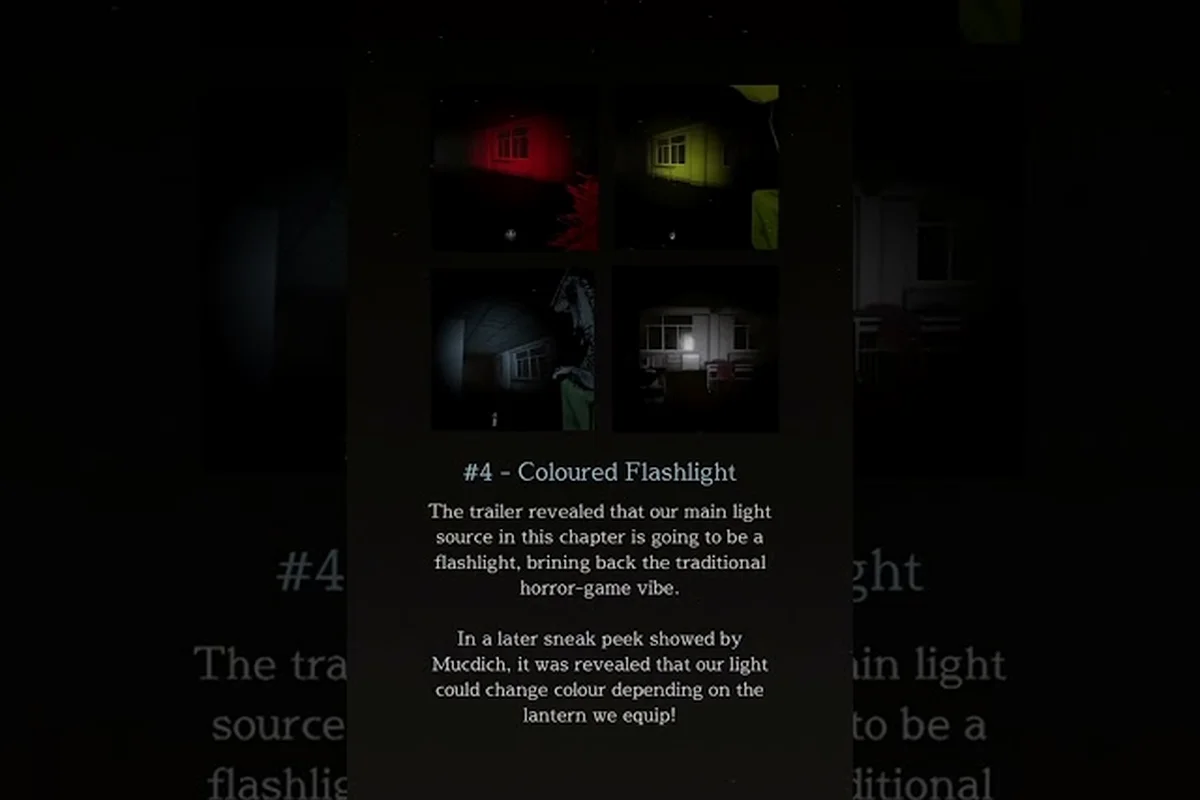
The Mimic’s hidden details reward careful observation because recurring symbols, mirrored rooms, and altered props can point toward connections among its books. For example, tracing a repeated room layout or displaced object across scenes can reveal whether an apparent change is a deliberate story link rather than ordinary set variation. Comparing these motifs with the Mimic yokai’s folklore and Japanese mythology also helps separate visual inheritance from confirmed canon, allowing readers to build a defensible connected story without treating every resemblance as intentional evidence.
Symbols and objects in The Mimic hidden details
The most useful symbols are not decorative stand-ins for Japanese culture; they work as visual prompts. A repeated mark can connect a location, an object, and a narrative event, while mirrors can indicate that the environment is reflecting something other than the player’s immediate surroundings. That makes The Mimic symbols explained a question of context as much as identification.
Repeated marks and visual anchors
Players tend to recognize a symbol after seeing it more than once. The first appearance may establish a theme, the second may narrow its meaning, and later appearances can confirm that two books share a hidden thread. Because the game’s imagery is intentionally unsettling, the safest approach is to record where each mark appears instead of assigning a fixed meaning too early.
| Observable clue | Likely reading method | Story value |
|---|---|---|
| Repeated symbol | Compare shape, placement, and nearby objects | Suggests a shared motif across books |
| Marked door or object | Follow it after disturbing a room | Often functions as a transformation clue |
| Mirror image | Compare the reflection with nearby facts | May expose false or reversed information |
| Changed furniture | Record position before and after an event | Can reveal manipulation, memory, or passage of time |
| Repeated sound or phrase | Compare chapters and delivery details | Links otherwise separate scenes |
These clues should be treated as a pattern system rather than a puzzle with one answer. Community reports often describe mirrors and rearranged rooms as the most memorable recurring devices, but the game’s story remains ambiguous, so player interpretation is more defensible than a definitive symbol dictionary.
Mirrors as unreliable evidence
A mirror is more than a visual symbol in The Mimic. It can show a room from a different angle, preserve an image after the surrounding object changes, or make the player question what counts as the present. The reflection should therefore be checked against three facts: what the player saw before entering, what the mirror displays, and what remains after leaving the room.
This sequence turns a suspicious image into evidence. If the reflection contains an object that is absent in reality, the scene may be predicting a later event. If it shows an earlier arrangement, it may preserve the past. If both sides match but a new mark appears afterward, the mirror may be acting as a boundary rather than a portal.
The broader The Mimic lore explained provides useful context for distinguishing mimic behavior from ordinary visual tricks. A mimic copies recognizable forms, yet these rooms may use copied forms to communicate with the player, which makes every reflection both evidence and a possible imitation.
Japanese mythology and yokai influences
The Mimic draws on the idea of a being that assumes a familiar form, but that broad resemblance does not mean every monster has a one-to-one mythological source. The clearest comparison is the mimic-yokai tradition: supernatural entities associated with copying, deception, altered identities, or dangerous faces hidden beneath an ordinary exterior.
The Mimic Japanese mythology connection
Japanese folklore includes many local figures whose appearance, behavior, and origin differ by region. That variation matters because The Mimic uses atmosphere and motifs rather than presenting a clean encyclopedia entry for one named spirit. The strongest evidence lies in recurring traits: false familiarity, reflective surfaces, strange rooms, and beings that imitate human expectations.
| Folklore trait | Game interpretation | Caution |
|---|---|---|
| Shapeshifting | An entity adopts a recognizable identity | The game may fictionalize the tradition |
| Hidden true face | A harmless exterior conceals danger | Similarity does not prove a direct source |
| Reflection or doubling | A scene shows a second version of reality | Motifs can also serve mechanical horror |
| Repetition | A room recreates a familiar action | The repetition may be narrative, not mythological |
| Ritual or mask imagery | A symbol suggests identity and transformation | Do not assign a meaning without corroboration |
This makes The Mimic’s Japanese mythology connection a broad framework for interpretation, not a source-identification chart. The game’s supernatural world echoes older fears while adding its own rules about books, mimics, and human behavior: a familiar face can conceal a hidden true form, reflective doubles can undermine the player’s sense of reality, and repeated actions can turn a room into a narrative trap. Those connections explain why The Mimic feels rooted in yokai folklore and urban legend imagery without requiring every apparition to map neatly onto one named spirit.
Yokai folklore versus urban legends
Yokai folklore and modern urban legends share a talent for making ordinary spaces feel unstable, but their framing differs. A traditional tale often explains a local belief or warns of a particular danger, whereas an urban legend is usually transmitted as a present-day claim that may never have evidence behind it. The Mimic borrows the sensation of a story repeated until it seems familiar, then makes that familiarity dangerous.
| Source tradition | Main fear | Connection to The Mimic |
|---|---|---|
| Yokai folklore | Supernatural beings intruding on daily life | Mimics appropriate human environments |
| Urban legend | A familiar place hides an unbelievable truth | Rooms and objects feel deliberately staged |
| Mirror folklore | Reflection may reveal a hidden identity | Mirrors challenge trust in appearances |
| Doppelganger folklore | A double interferes with the original | Doubling supports themes of imitation and control |
The Mimic yokai folklore reading is strongest when a creature’s behavior reinforces the theme rather than merely matching a monster’s general appearance. The Mimic urban legend inspirations are similarly plausible at the storytelling level, especially where ordinary locations collapse into uncanny versions of themselves.
For a separate examination of how Japanese settings and legends inform the novels, use The Mimic Japanese urban legends overview. Comparing that account with the game’s visual evidence helps distinguish documented inspiration from community interpretation.
Hidden details that connect the books
Book structure is central to The Mimic, because the novels are not merely manuals for their chapters. They can operate like artifacts within the wider story, reflecting events, carrying incomplete records, or reproducing patterns that the player later encounters in the game world. This is where The Mimic books connected story becomes less about a single book title and more about a chain of textual and environmental clues.
What survives between books
The strongest connection is recurrence with variation. A name, image, location, or emotional theme may return in a later book while one important element has changed. The repetition establishes continuity; the alteration may indicate concealed motive, unreliable narration, or a history different from the one presented on the surface.
| Connection type | What to compare | Interpretation |
|---|---|---|
| Repeated image | Symbol shape and context | A motif crossing book boundaries |
| Changed location | Layout, objects, or stated history | A location revisited under altered conditions |
| Mirrored scene | Same event from another perspective | Contradictory testimony or identity swap |
| Matching phrase | Exact wording and speaker | Possible quotation, echo, or inherited memory |
| Altered object | Same item with new condition | Continuity through damage, possession, or time |
A useful notebook should have separate columns for observation and inference. Keeping the raw observation intact prevents a later theory from rewriting what the player actually saw, while the inference column makes it easier to spot a pattern once the next book begins repeating it.
Clues from the trailers
The official Book III trailer by CTStudios can provide visual evidence that supplements playtime. Watch for recurring symbols, reflective surfaces, unusual room arrangements, and imagery that resembles earlier chapters. Trailer editing may combine separate scenes, so a visible match is still a lead rather than proof of chronological order.
| Trailer observation | Verification method | Best use |
|---|---|---|
| Repeated emblem | Compare with scenes in each book | Identify cross-book motif |
| Mirror-centered shot | Check reflection for impossible details | Track a possible double or distortion |
| Familiar room type | Compare furniture and floor plan | Find altered-location echoes |
| Book or document image | Match its design to in-game pages | Investigate narrative source material |
Treat the trailer as a visual index for The Mimic’s hidden details rather than a replacement for playing through Books I–III. Its edited shots can suggest a recurring emblem, a mirror-centered distortion, or a familiar room with an altered floor plan, but none establishes the intended order or interpretation on its own. For example, a repeated emblem in the Book III trailer should be checked against scenes from each book to determine whether it is a cross-book motif; a mirror image should be compared frame by frame for an impossible reflection that may indicate a double or a yokai-related distortion. Only the full experience reveals whether a symbol is prophecy, inherited memory, or psychological manipulation.
Reading order and evidence quality
The novels, game chapters, and trailers may tell related portions of the same story in different forms. That makes a stable reading order valuable, especially when a later scene appears to explain an earlier one. The complete order of The Mimic books helps prevent accidental spoilers and provides a basis for comparing texts in sequence.
Strong interpretation follows three rules: preserve the sequence of novels, game chapters, and trailers; classify each clue as an observed image, a confirmed detail, or a community theory; and require corroboration across independent sources before treating it as a deliberate connection. For example, a yokai symbol appearing in a novel scene and again in a trailer environment can support a folklore interpretation only when its shape, placement, and narrative context align, while a shared urban legend motif without matching visual or behavioral evidence remains suggestive rather than conclusive. This distinction helps separate meaningful The Mimic hidden details from coincidental resemblances and prevents the Japanese mythology and yokai folklore connections from being overstated.
-
Record the exact image or line before searching for a theory.
-
Separate direct observation, developer-confirmed context, and community interpretation.
-
Look for at least two independent details before connecting separate books.
A single striking resemblance may be accidental or deliberately planted. Several observations across novels, environments, and trailers are more persuasive because they can be compared as an evidence set rather than isolated curiosities. For example, repeated yokai symbols should be checked for matching shape, placement, and narrative function, while recurring urban legend imagery needs corroboration from a novel scene, game chapter, or trailer before it can support a claim about The Mimic story connections. This is why The Mimic hidden details become clearer when the complete order of the books is used to trace when each motif first appears, whether later books develop it, and which Japanese mythology or yokai folklore interpretations remain plausible rather than merely speculative.
Reading symbols as story clues
Symbols work best when evaluated through repeated placement, physical behavior, and narrative timing. Treating every mark as a secret button can make players overlook atmosphere, while dismissing the imagery as decoration can erase genuine connections. A middle approach asks what each symbol changes.
A symbol observation method
Begin with the room before touching anything. Note the symbol’s position, color, shape, and the objects surrounding it. Then interact, wait for the room to settle, and compare what changed. Finally, compare that result with a later scene where the same symbol or a close variant appears.
| Step | Record | Why it matters |
|---|---|---|
| Observe | Shape, color, placement | Establishes a baseline without interpretation |
| Compare | Nearby doors, mirrors, furniture | Reveals local relationships |
| Interact | Which object changes first | Links the symbol to a possible trigger |
| Wait | Whether movement occurs afterward | Tests delayed transformation effects |
| Revisit | Which elements remain altered | Determines whether the clue persists |
| Connect | Occurrences across books | Builds a cross-media pattern |
This method is especially effective for The Mimic symbols explained because it converts ambiguity into a repeatable process. The result may not be a translation key; it may instead reveal that a symbol marks events where identity, memory, or physical space becomes unstable.
Objects that behave like sentences
Furniture can function as language in the Mimic. A chair facing the wrong direction, a bed positioned where no bedroom existed, or a table carrying too many settings may suggest something about who inhabits the space. The object may preserve a relationship that the surrounding narrative tries to conceal.
Objects that move or multiply are especially valuable because they establish action. Something that merely looks strange may reflect the game’s visual design, while something that changes after a mimic appears seems to belong to the event itself. That distinction helps separate meaningful story evidence from atmospheric dressing.
Mirrors and contradictions
When a reflection conflicts with the room, record each side separately. Include what the reflection contains, what the real space contains, and what changed once the player crossed the threshold. This creates a clean comparison that can be matched against later books.
For instance, a mirror might show the doorway that the player entered from, even though the physical doorway has vanished. A reflection might also reveal an earlier furnishing arrangement. Those cases imply different functions, but both support a larger idea: the Mimic world permits separated moments or perspectives to overlap.
A practical evidence log
A simple evidence log prevents later memories from blending together, especially when The Mimic shifts between chapters, rooms, and story connections. Record the chapter and unique room identifier, the exact symbol, mirror, or object position, the action that triggered a change, and the visible result; separately note any proposed link to Japanese mythology, yokai folklore, or another book scene. For example, if a mirror changes after the mimic is defeated, document the chapter, mirror location, color, and timing before writing “linked to a shape-shifting spirit.” Add screenshots only if the game permits them, and label interpretation separately from observation so a compelling theory never replaces the underlying hidden detail.
| Column | Example use | Recommended detail |
|---|---|---|
| Location | Unique room identifier | Chapter and visual description |
| Clue | Symbol, mirror, object, phrase | Exact position and color |
| Trigger | Relevant action | Door opened, mimic defeated, time passed |
| Observation | Visible change | Object moved or disappeared |
| Interpretation | Possible meaning | Mark as speculation |
| Connection | Related book or scene | Chapter, trailer, or previous event |
Repeated patterns become easier to detect when the same fields are used every time. Compare, for example, a mirror’s position before and after a chapter transition: an unchanged reflection recorded under the same room identifier supports an environmental pattern, while a shift in color or location following the mimic’s defeat supports a possible yokai connection. This distinction matters because a satisfying theory can otherwise outrun the evidence; log the observable symbol, object, or phrase first, then attach any Japanese mythology or The Mimic book-connection interpretation as a separate, clearly labeled hypothesis.
Separating confirmed lore from player theory
The Mimic hidden details occupy a space between deliberately planted clues and ambiguous symbolism. Some facts can be observed directly in the game, while interpretations about real-world folklore remain community analysis. Clear labels prevent an evocative reading from being presented as confirmed canon.
Evidence tiers for hidden details
| Claim | Evidence level | Responsible wording |
|---|---|---|
| A symbol appears in two locations | Directly observable | “The symbol recurs” |
| A room changes after an interaction | Directly observable | “The furniture rearranges” |
| A later book echoes an earlier image | Comparative observation | “The scene visually parallels” |
| The symbol represents a named spirit | Interpretive | “It may evoke” or “players have compared it with” |
| A trailer confirms a planned event | Official visual source | “The official trailer shows” |
| The books form one continuous account | Structural interpretation | “The books can be read as” |
This distinction matters because ambiguity can be part of the storytelling, not a defect to eliminate. When the game leaves room for several explanations, presenting one as absolute may reduce the richness of the lore and create false certainty for readers who want to explore it carefully.
Community reports and recurring observations
Player communities are valuable for noticing details across long playthroughs. Community reports often focus on mirrors, displaced objects, repeated signs, and matching imagery between the novels and game. Those reports are most persuasive when they identify a scene, describe the change, and distinguish personal speculation from the exact visual sequence.
The story explanation and chronology can then help determine whether two clues belong to the same sequence. A thematic resemblance may connect books without proving that the events happened consecutively, so chronology is a necessary second check after imagery.
What the games confirm and what they leave open
Official material can confirm what appears on screen: a trailer contains a particular image, a chapter contains a repeated emblem, and a novel includes a described passage. It cannot, by itself, confirm every fan interpretation of that material. The official trailer can confirm visible details, but a montage does not establish whether a shared symbol means a shared character, location, event, or thematic idea.
This is why careful lore analysis uses two layers. The first records observable evidence, such as the emblems repeated across The Mimic games or the yokai imagery linking them to Japanese mythology; the second explores why those details were included. For example, a symbol appearing in both game files and a novel passage may support a deliberate connection, but it cannot independently confirm a shared character or story. The second layer is therefore valuable interpretation, provided every claim remains clearly labeled and its evidence is traceable.
A checklist for uncovering connected clues
A focused checklist helps prevent missed details without turning the game into an endless image hunt. Record each category separately, then look for intersections. Repetition plus variation is the central rule: a clue becomes meaningful when it returns with a meaningful change.
Before moving between books
-
Photograph or describe every repeated emblem, especially when its placement differs.
-
Note mirrors that show missing people, objects, or alternative room arrangements.
-
Track furniture that moves without a visible character handling it.
-
Save unusual phrases, page designs, and recurring locations.
-
Mark scenes where the environment reacts to mimic behavior.
Before moving between books, record each observation with its book number, chapter or scene, and approximate location, then classify it as a repeated emblem, altered reflection, moved object, unusual phrase, or environment response. Comparing entries from Book 1 and Book 2 is more reliable than relying on memory because the same Yokai folklore symbol may appear in a new context, while a mirror anomaly or shifted furniture can signal a hidden connection between the books. This stable evidence helps separate deliberate Mimic clues from ordinary visual variation and makes recurring patterns easier to trace across the connected story.
During each new book
-
Compare the opening environment with earlier books before following the main path.
-
Look for the same symbol beside a different object or emotional theme.
-
Check whether a mirror presents the player from an impossible angle.
-
Notice when architecture resembles a remembered location but lacks one defining feature.
-
Separate a genuine callback from common horror imagery.
Visual echoes become more persuasive when color, composition, and timing all align; repeated red accents, distorted mirrors, or a shadow copied with a slight delay can link separate books into one deliberate pattern. Dialogue echoes work the same way: a recurring phrase gains meaning when its speaker changes, an emotion is inverted, or the same wording appears in a different context, turning a familiar line into a clue about the Mimic’s identity and the books’ connected story.
Building a final theory
A defensible theory should explain several details without contradicting direct observations. Ask whether it accounts for the mirror, the altered furniture, and the cross-book imagery. If it explains only one striking image while ignoring the rest, it may be an attractive but incomplete reading.
| Test | Strong theory | Weak theory |
|---|---|---|
| Scope | Explains details across multiple books | Relies on one scene |
| Evidence | Separates observation from inference | Presents speculation as fact |
| Contradictions | Accounts for conflicting imagery | Requires convenient exceptions |
| Folklore | Uses resemblance as context | Claims an exact, unverified source |
| Gameplay fit | Connects visuals to mimic behavior | Treats every object as a puzzle |
The strongest conclusion is not a single source for the yōkai, but a layered connection among the books and chapters: the mirror reflects a distorted likeness, the altered furniture suggests that a copy has displaced the original, and cross-book imagery implies that resemblance is being treated as a repeatable phenomenon. These details make the mimic more than a monster; it becomes a mechanism through which memory, identity, and the boundary between original and imitation become unstable. At the same time, the final theory must remain provisional, since folklore can explain the motif without proving an exact origin.
Frequently Asked Questions
Are The Mimic hidden details confirmed by developers?
Some details are directly observable, such as repeated symbols, mirrored spaces, and rearranged objects, but their precise meaning may remain interpretive. Official trailers and in-game scenes can confirm what appears; community theories can propose what it means. Treat each conclusion according to its evidence rather than assuming every visually connected image has one definitive explanation.
What do the symbols in The Mimic represent?
The symbols appear to connect environments, identity, and imitation, but the game does not present every mark as a straightforward translation. Their placement and the way nearby objects change provide the strongest clues. Recording repeated appearances across rooms and books is more reliable than assigning a universal meaning to a single symbol.
Is The Mimic based on a real Japanese yokai?
The game draws strongly on yokai folklore and modern urban legend techniques without necessarily adapting one specific creature. Its beings emphasize copying, concealed identities, and uncanny doubles, which overlap with several Japanese supernatural traditions. Similarities support a thematic connection, although they do not by themselves prove that every mimic has a direct mythological source.
Do the books and game tell the same story?
The books and game share characters, images, and narrative threads, but they may present the same history through different perspectives or formats. Visual parallels can reveal connections without establishing exact chronology. Reading the novels in sequence and comparing specific scenes provides a stronger basis for understanding The Mimic books connected story than isolated references.
Are mirrors important clues in the game?
Mirrors are among the most noticeable recurring elements because they can contradict the room, reveal another angle, or preserve information that seems out of place. Their exact function may shift from scene to scene, so the safest method is to compare what each side shows before and after the player interacts with the surrounding environment.
The Mimic hidden details form a layered pattern rather than a single code: symbols repeat, mirrors complicate what is real, and altered props connect the game world to its books. The most rewarding approach is to preserve observations, compare variations across the connected story, and label folklore or narrative conclusions with the confidence they deserve.