
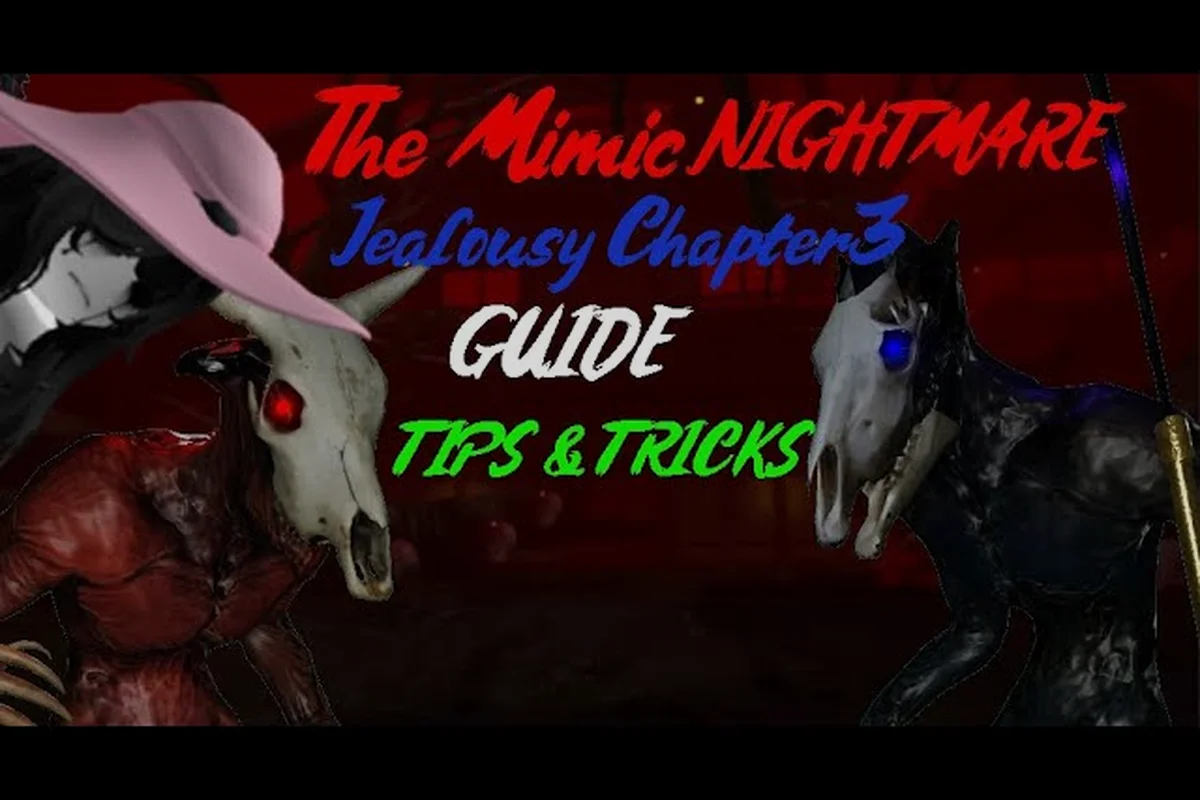
The Mimic Enzukai matters because his jealousy-themed behavior turns a routine monster chase into a thread in the larger Beast of Jealousy mystery. His Book 2 encounters provide concrete clues through mimic transformations and reported lore, while The Mimic Netamo, The Mimic Yuma the mimic, The Mimic Omukade, and The Mimic Hiachi offer useful comparisons for identifying how Enzukai’s behavior differs. Tracking those differences also explains why his Mimic jumpscares feel tied to a larger pattern rather than serving as isolated horror set pieces.
The Mimic Enzukai: Encounter Overview
The Mimic Enzukai is best understood as a story-linked horror encounter rather than an isolated monster. The available evidence centers on his appearance, his association with jealousy, and the clues players encounter while progressing through Book 2. Because the game can be unsettling quickly, understanding his role gives players a clearer reason to observe each room, sound, and confrontation instead of treating Enzukai as random scenery.
| Enzukai detail | What players should look for | Practical value |
|---|---|---|
| Book 2 presence | Enzukai appears within the jealousy-related storyline | Confirms that the encounter is connected to story progression |
| Jealousy theme | His behavior mirrors resentment and fixation | Encourages attention to environmental storytelling |
| Threat pattern | Sudden danger is easier to survive when its source is anticipated | Reduces deaths caused by unexpected attacks |
| Lore value | Enzukai connects with broader Beast of Jealousy theories | Gives progression a narrative purpose beyond combat |
What Makes Enzukai Different?
Most confrontations in The Mimic depend on fast recognition and reaction. The Mimic Enzukai adds another layer: his identity is tied to an emotion as much as an attack pattern. When a character’s jealousy becomes the apparent cause of danger, the encounter carries symbolic weight even if the exact interpretation remains open to player discussion.
Players should therefore separate two kinds of evidence. The first is observable encounter evidence, including where Enzukai appears, how quickly he attacks, and whether he reacts to nearby characters or objects. The second is interpretive evidence, such as the connection between the Beast of Jealousy, other named entities, and Book 2 events. Treating these separately prevents a compelling theory from becoming an unsupported fact.
The Wider Beast Group
Enzukai benefits from comparison with the game’s other creatures because its Book 2 clues point toward jealousy rather than a broader Mimic identity. The four beasts lore overview helps separate Enzukai’s resentment and emotional fixation from Netamo, Omukade, and Hiachi, whose defining associations concern their own creature identities. This distinction matters when evaluating The Mimic Netamo and The Mimic Yuma the mimic: shared visual motifs or a shared location may link encounters without proving that the player is facing the same Mimic.
| Creature or term | Most useful comparison point | Key distinction |
|---|---|---|
| Enzukai | Jealousy-linked behavior and Book 2 clues | Focuses on resentment and emotional fixation |
| Netamo | A separate named monster with its own encounter identity | Should not be treated as an alternate label for Enzukai |
| Omukade | Appearance and lair associations | Best examined through location rather than jealousy clues |
| Hiachi | The game includes both hostile and non-hostile monster traditions | Its friendliness makes it useful as a contrast |
| Yuma | A name players connect with the Mimic’s cast | Its appearance near a Mimic does not automatically identify the Mimic itself |
This distinction is particularly useful when reading The Mimic Netamo or The Mimic Yuma the mimic. Similar visual motifs or shared locations do not prove that two entities are the same creature. A sound theory should explain the chapter, the creature’s behavior, and the player’s role in the scene.
Jealousy Mechanics and Behavioral Clues
The strongest Enzukai interpretation begins with the jealousy feedback loop: something valuable or desirable becomes visible, a character responds possessively, and that fixation turns into immediate physical danger. This does not require players to assume that every object is an interactive item. Instead, it encourages them to inspect the emotional logic of a scene and identify which relationship or possession the encounter appears to challenge.
Reading the Scene Before the Attack
A reliable investigation involves three passes through the room. First, look for objects placed closer to one character than the others. Second, note doors, mirrors, photographs, or other images that frame another person as the center of attention. Third, watch for behavioral repetition: a glance, a blocked path, or a repeated movement near the same target.
| Observation | Interpretation to test | Evidence strength |
|---|---|---|
| One object receives unusual emphasis | It may represent the object of fixation | Suggestive |
| A character is repeatedly framed beside another | Jealousy may involve comparison or rivalry | Suggestive |
| The same sound triggers a reaction | The monster may be tied to a recurring motif | Moderate |
| Enzukai appears after a possessive act | The scene may dramatize jealousy becoming violence | Stronger if repeated |
| A detail appears in several Book 2 scenes | It may connect Enzukai to the larger narrative | Strong when repeated |
Community experience is especially relevant here because environmental details can be easier to miss during a panic encounter. Reported player observations often note that the story scenes reward careful examination, although individual recollections may differ by platform or version. The safest approach is to record what appears on screen, then compare it with other scenes rather than relying on a single remembered detail.
The Mimic as a Story Device
Some players encounter the titular Mimic before they understand that it can represent more than a simple enemy category. That uncertainty is useful when studying Enzukai because the game’s creatures may parody human fear without following realistic rules. A jealous response can be exaggerated, theatrical, or physically impossible, yet the emotional cause remains readable.
The distinction matters for The Mimic Yuma the mimic as a search term. Yuma can be understood as part of the game’s cast of Mimics, but the label does not automatically establish the same identity, behavior, or narrative purpose as Enzukai. The broader overview of the game’s four beasts is useful for separating named Mimics, supernatural beasts, and entities that are friendly or neutral.
Replay notes for identifying Enzukai's scripted trigger
When revisiting Book 2 footage, a replay, or a second playthrough of The Mimic, treat Enzukai’s appearance as a repeatable encounter rather than relying on a single remembered jumpscare. Recheck the sequence from the same starting point, note whether Enzukai enters before or after Netamo appears, and compare the moment of danger with later scenes involving Yuma the Mimic or Omukade. This makes it possible to distinguish a scripted Enzukai trigger from a broader pattern of jealousy, possession, and blocked access without mistaking atmosphere for confirmed lore.
-
Record the room: Write down the floor or chapter where Enzukai appears.
-
List nearby characters: Note everyone visible before the encounter begins.
-
Track the focal point: Determine whether a person, object, or image receives the most attention.
-
Mark the trigger: Note what happens immediately before Enzukai becomes dangerous.
-
Separate sight from sound: Determine whether the cue is visual, auditory, or both.
-
Compare later scenes: Look for jealousy imagery, blocked access, or repeated possession.
-
Preserve uncertainty: Keep confirmed events distinct from story interpretation.
This method produces evidence that can survive patch changes and personal interpretation. For example, if Enzukai appears after Netamo in Book 2 on a repeat playthrough but before Netamo after a patch, that discrepancy becomes a testable lead rather than proof of a scripted trigger. Comparing the same room with scenes involving Yuma the Mimic, Omukade, or Hiachi can show whether Enzukai belongs to a recurring jealousy and possession pattern; otherwise, the footage supports only a cautious observation about The Mimic Enzukai, not official lore.
Comparing Enzukai With Other Mimic Monsters
Comparing monsters is useful only when each name represents a distinct encounter. The Mimic Netamo, The Mimic Omukade, The Mimic Hiachi, and Enzukai can share visual motifs while still serving different narrative roles. Players often group them because all four are associated with the game’s monster roster, but behavior, setting, and thematic cues offer a better classification.
| Monster name | Strongest known angle | Best place to investigate | Main confusion to avoid |
|---|---|---|---|
| Enzukai | Jealousy and emotional fixation | Book 2 scenes | Assuming every red visual detail proves the same identity |
| Netamo | Independent named entity and encounter presence | Chapters featuring Netamo | Treating shared design elements as one character |
| Omukade | Monster and lair imagery | Omukade’s associated location | Letting physical location substitute for behavioral identity |
| Hiachi | Mixed friendly and threatening monster traditions | Scenes where Hiachi approaches calmly | Assuming every monster attack is hostile by default |
| Yuma | Mimic-associated name within the cast | Scenes containing Yuma and other Mimics | Equating “Mimic” with one single form |
The hotel map and location guide can separate environmental evidence from creature evidence. A monster linked to the Omukade lair is not thereby connected to Enzukai’s jealousy storyline. Maps also help players revisit rooms without guessing where an important scene occurred, making clue collection more efficient.
Similar Does Not Mean Identical
A sound monster comparison should use at least two independent categories. Appearance can be one category, but it is often unreliable when several enemies share silhouettes or animation conventions. Behavior, story placement, and recurring environmental symbols usually provide stronger distinctions. If two entities appear in the same chapter, that overlap supports association but does not prove common identity.
Thematic separation is especially important. Enzukai’s apparent jealousy should not be used to explain every threatening creature, just as Hiachi’s occasional friendliness should not imply that other monsters are harmless. These contradictions may be intentional. The game’s horror often works by making a familiar assumption unreliable, so a creature can surprise players without contradicting its established story role.
Evaluating Community Theories
Player reports are most credible when they describe specific scenes. A useful community claim should identify a location, describe an action, and connect that action to a visible detail. Claims without those elements remain theories, even if many players repeat them. As of the available material, the strongest supported takeaway is that Enzukai is tied to jealousy and Book 2, while the precise mechanism behind his appearance remains a matter for careful interpretation.
Surviving The Mimic Enzukai and Other Jumpscares
The best response to Enzukai is preparation rather than memorization of a single route. He functions within the same jump-heavy design as other encounters, so dependable movement, awareness, and knowledge of safe pauses matter more than one perfect trick. The monster behavior and jumpscare overview provides useful context for comparing threat intensity, while this guide focuses on what makes Enzukai’s story context distinct.
| Preparation step | What it prevents | Why it helps with Enzukai |
|---|---|---|
| Keep a clear escape route | Cornering during a surprise | Gives room to react to an emotional or environmental trigger |
| Listen before turning | Missing a subtle cue | Helps connect sound to the jealousy motif |
| Avoid unnecessary item handling | Triggering unrelated reactions | Prevents distraction from a meaningful clue |
| Save before uncertain scenes | Losing progress after a surprise | Preserves time to revisit and compare details |
| Record the immediate trigger | Repeating mistakes | Builds a reliable personal pattern database |
| Use a bright lamp | Missing a silhouette | Clarifies the source of a sudden appearance |
A Controlled Encounter Plan
When entering an Enzukai scene, first scan the floor instead of the monster. Identify the exits, corners, and any object that appears centered in the composition. Then listen through the first few seconds of movement. If a sound repeats, mark its location mentally and turn toward it only after confirming that it is not a false cue.
Positioning matters because jealousy-themed encounters can encourage players to crowd around the object of fixation. Staying out of the center gives more reaction time and may reveal an exit that becomes blocked. When the encounter ends, resist rushing onward immediately. A short observation can confirm the trigger without turning the scene into an extended farming session.
Why The Mimic Jumpscares Still Matter
The Mimic jumpscares work because they interrupt expectation, even when the creature responsible for a scare is not Enzukai. The sound, animation, and sudden camera change can force a reaction before the player identifies a target. For Enzukai, the emotional setup may amplify that danger: a room about rivalry becomes threatening because the creature appears to act on the emotion already established in the scene.
| Reaction habit | Better response |
|---|---|
| Sprinting at every noise | Pause briefly, locate the cue, then choose a route |
| Looking only at the nearest threat | Scan for a second movement or environmental change |
| Grabbing every interactable object | Observe first, then interact only when the scene supports it |
| Treating every creature as hostile | Check whether the current entity behaves differently |
| Rushing after an encounter | Note the trigger and changed object arrangement |
These habits apply to the broader cast, but they are especially valuable when comparing Enzukai with The Mimic Hiachi. A startled player may mistake a non-hostile approach for an attack, while another player may treat a subtle scene cue as harmless. The difference is not courage; it is accurate observation under pressure.
Book 2 Clues and the Jealousy Storyline
Book 2 matters because it gives Enzukai a narrative frame. The clue chain does not need to depend on a single hidden object or an isolated line of dialogue. It can be built from repeated ideas: a favored person, an exclusive possession, a blocked relationship, and a reaction that turns resentment into violence. When several of those elements repeat, the jealousy reading becomes more persuasive.
Building a Clue Timeline
A timeline separates what Enzukai does from what the surrounding story suggests. Divide the evidence into the condition before the encounter, the trigger, the reaction, and the aftermath. This format also exposes missing links that fan theories tend to gloss over.
| Timeline slot | Questions to answer | Example significance |
|---|---|---|
| Before | Who or what receives special attention? | Establishes the possible object of jealousy |
| Trigger | What changes immediately before danger? | Connects action to emotion |
| Reaction | Whom does Enzukai seem to target? | Suggests rivalry or fixation |
| After | What remains changed in the room? | May preserve evidence of the encounter |
When constructing this timeline, avoid assigning motives that are not visible. If the scene shows Enzukai blocking a doorway, “the path was blocked” is factual; “he wanted to keep one character away” is interpretation. Keeping the labels separate makes the final theory stronger and easier to revise.
Cross-Character Clues
Enzukai’s story may gain meaning through the reactions of other characters rather than through a direct exposition dump. The secondary character guide is a practical companion for identifying who appears near important confrontations. Track who avoids the focal object, who stands closest to it, and who reacts after the attack rather than before it.
A four-part clue set is especially persuasive because each part tests a different kind of evidence for Enzukai’s role in The Mimic Book 2: a character’s repeated presence near the focal object, a reaction that diverges from the group, a blocked route or relationship, and a later event that gives an earlier emotion new significance. The strongest case emerges when these signals involve specific figures such as Netamo, Yuma, Omukade, or Hiachi, since their contrasting behavior can distinguish coincidence from deliberate narrative design. No one reaction should carry the theory alone; the value comes from several independently recorded clues converging around Enzukai.
-
Visual repetition: the same person or object appears in multiple scenes.
-
Behavioral contrast: one character reacts differently from everyone else.
-
Spatial exclusion: a path or relationship is deliberately blocked.
-
Narrative payoff: later events make the earlier jealousy meaningful.
No single category should carry the entire theory, because Enzukai’s role in The Mimic Book 2 depends on how the clues interact. For example, if Netamo repeatedly appears near Enzukai while Yuma blocks access to that scene, and Hiachi reacts only after the jumpscare, the sequence becomes stronger than any one observation. Omukade can provide a contrast: a character who stays close to the group without showing fear may suggest that the threat lies in Enzukai’s relationship to him. When at least three signals point to the same conclusion, Enzukai becomes more than a thematic label and functions as a deliberate link in the Book 2 mystery, helping readers distinguish concealed motive from coincidental positioning.
What the Evidence Does Not Prove
Even a strong story reading leaves some questions open. It does not automatically reveal who created every monster, whether jealousy causes every death, or whether Enzukai acts independently of another beast. It also does not make the player character responsible for the conflict. These limitations matter because horror stories often encourage players to connect every detail into one final explanation.
The most reliable conclusion is that Enzukai personifies or externalizes jealousy within the Book 2 narrative. More specific claims should remain framed as interpretations until additional scenes or official material confirm them. That distinction keeps community lore useful without turning it into fabricated canon.
Final Evidence Review
The Mimic Enzukai is most valuable as a lens for reading the whole story, not merely as one monster to defeat. His jealousy theme rewards close attention to characters, objects, sound, and repetition. That makes his encounters useful even when the exact source of every clue remains uncertain.
A useful test is to trace how Enzukai’s jealousy changes an otherwise routine Book 2 scene: does a repeated object, sound, or character reaction make his presence felt before he attacks? Comparing those details with the separate Netamo, Omukade, Hiachi, and Yuma encounters helps prevent one mimic’s behavior from being projected onto the others. The goal is a scene-by-scene evidence chain, not a generic jumpscare summary, because Enzukai becomes more convincing when the story’s patterns converge on him rather than on memory alone.
-
Confirm that Enzukai appears in Book 2 rather than transferring evidence from another chapter.
-
Separate visible behavior from emotional inference.
-
Compare his scenes with Netamo, Omukade, Hiachi, and Yuma without assuming shared identity.
-
Check whether an environmental clue recurs before, during, or after an encounter.
-
Record scene details instead of relying on a generalized memory of the jumpscare.
-
Mark community interpretations as theories unless an authoritative source confirms them.
Taken together, the evidence supports Enzukai as the jealousy-linked beast in The Mimic’s broader horror. His greatest impact comes from turning an emotion into an immediate threat, which makes every chapter 2 scene feel more suspicious once the pattern becomes clear.
Frequently Asked Questions
Who is The Mimic Enzukai?
The Mimic Enzukai is a jealousy-linked monster encountered within The Mimic’s Book 2 material. His apparent fixation on another character or object supports a thematic connection to the Beast of Jealousy, although the exact origin of his behavior remains open to interpretation.
Is Enzukai the same creature as Netamo, Omukade, or Hiachi?
No confirmed evidence identifies Enzukai as another name for Netamo, Omukade, or Hiachi. They may share visual or narrative motifs, but each has a distinct thematic or behavioral identity, so grouping them requires stronger proof than a shared location or appearance.
What clues point to the Beast of Jealousy in Book 2?
The strongest clues involve fixation, rivalry, blocked access, and objects or people receiving disproportionate attention. Repetition across scenes matters more than one isolated detail, so a reliable analysis should compare Enzukai’s behavior with the wider Book 2 story before drawing a conclusion.
How should players handle Enzukai’s jumpscares?
Keep an exit visible, listen for repeated cues, and observe the room before grabbing objects. After the encounter, note what triggered Enzukai and what changed in the environment. That record can reveal the jealousy motif more effectively than memorizing a single encounter route.
Is the official explanation for Enzukai’s behavior known?
The available material clearly associates Enzukai with jealousy and Book 2, but the finer details of his origin and motives are better treated as community interpretation. Players should distinguish confirmed encounter events from narrative theories, especially when comparing the broader Beast of Jealousy lore.